
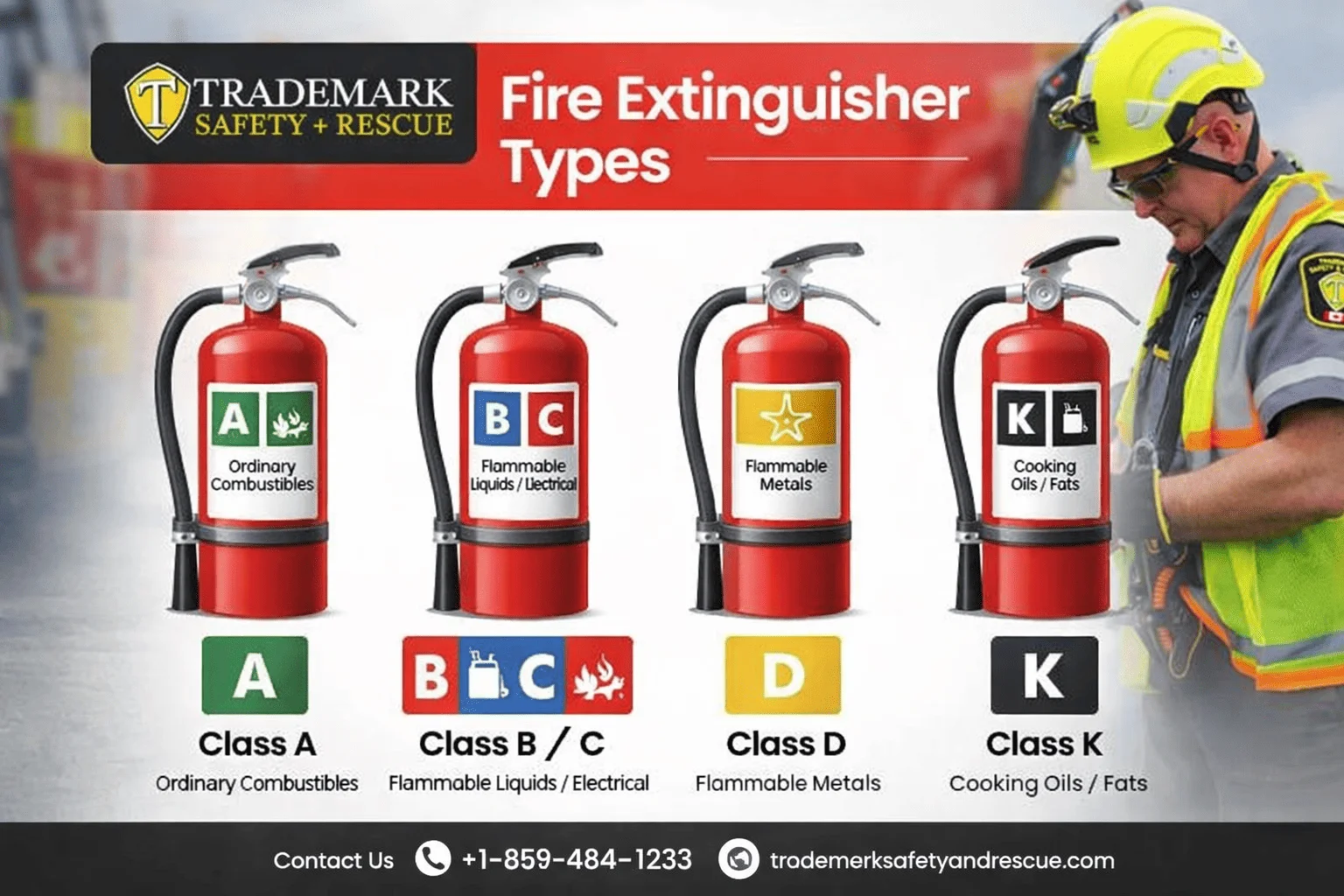
Fire safety is often treated as something that sits in the background. Extinguishers are mounted, tags are checked, and inspections are passed. But when a fire actually breaks out, preparation suddenly becomes very real. In those moments, understanding fire extinguisher types is not about policy or paperwork — it’s about making the right decision quickly and safely.
At Trademark Safety + Rescue, one of the most common issues we encounter isn’t the absence of extinguishers. It’s confusion about which one should be used, when it should be used, and when it should not be used at all.
Fires Are Not All the Same
A fire caused by stacked cardboard behaves very differently from a fire involving fuel, cooking oil, or energized electrical equipment. Each situation carries its own risks, and fire extinguishers are designed specifically to address those differences.
Water extinguishers are intended for ordinary combustible materials such as wood, paper, and fabric. They work by cooling the fire and removing heat. In the right environment, they are effective and straightforward. In the wrong environment, such as near electrical panels or flammable liquids, they can become extremely dangerous.
Foam extinguishers are commonly used where flammable liquids are present. They suppress fire by forming a layer over the burning surface, cutting off oxygen. These are often found in workshops, fueling areas, and industrial settings. However, they are not universal solutions and should be placed only where appropriate risks exist.
Dry chemical extinguishers are widely used due to their ability to handle multiple fire scenarios. They can interrupt the chemical reaction of fires involving solids, liquids, and electrical sources. While effective, the residue they leave behind can damage equipment, contaminate products, and require extensive cleanup — something that should be considered during planning, not after an incident.
CO₂ extinguishers are primarily intended for electrical fires. They work by displacing oxygen and do not leave residue, making them suitable for offices, control rooms, and server areas. However, they are not effective on deep-seated fires involving solid materials and should not be relied upon outside their intended use.
Wet chemical extinguishers are essential in environments where cooking oils and fats are present. These fires burn at high temperatures and can easily reignite. Wet chemical agents cool the fire and create a protective layer that helps prevent flare-ups, which is why they are critical in commercial kitchens.
Why Misuse Is a Serious Risk
Having extinguishers available does not automatically mean a space is safe. Using the wrong extinguisher can escalate a situation within seconds. Water on a grease fire, for example, can cause flames to spread rapidly. Powder in sensitive environments can cause unnecessary damage and downtime.
This is why understanding fire extinguisher types goes far beyond compliance. It directly impacts how people respond under pressure. In emergencies, hesitation and uncertainty often come from lack of clarity — not lack of equipment.
Placement and Visibility Matter
Another issue seen frequently is poor placement. Extinguishers should be easy to locate, clearly visible, and positioned near higher-risk areas. They should never be blocked by storage, furniture, or equipment.
Consistent placement across a facility helps reduce confusion. Clear signage and readable labels allow people to identify the correct extinguisher quickly, even if they have limited training.
Training Is Not Optional
Even the best equipment is ineffective if people don’t know how to use it. Basic fire extinguisher training can significantly reduce panic during an incident. Employees should understand the PASS method — Pull, Aim, Squeeze, Sweep — but also recognize situations where evacuation is the safer choice.
Fire extinguishers are meant for early-stage fires. They are not a replacement for evacuation or emergency response when a fire has already spread.
Regular refresher training helps keep this knowledge current. Without it, people forget — especially if they’ve never had to use an extinguisher before.
Maintenance and Inspection
An extinguisher that hasn’t been maintained is unreliable. Pressure loss, damaged hoses, expired agents, and broken seals are all issues that can cause failure during an emergency.
Routine inspections, along with scheduled professional servicing, ensure extinguishers will function when needed. Skipping maintenance creates a false sense of security — one that often isn’t discovered until it’s too late.
Choosing the Right Setup
There is no single extinguisher setup that works for every environment. Offices, warehouses, kitchens, manufacturing facilities, and construction sites all face different fire risks. Selecting the correct combination requires evaluating materials, equipment, and how people actually use the space.
At Trademark Safety + Rescue, fire protection planning is based on real-world conditions, not just minimum requirements. Proper selection, placement, and training ensure that fire extinguisher types align with actual hazards, not assumptions.
Final Thoughts
Fire safety works best when it’s prepared quietly and maintained consistently. Understanding fire extinguisher types, knowing where they are located, and ensuring people are trained to use them properly can prevent minor incidents from turning into serious emergencies.
Leave a Reply